






What is a USB based vector network analyzer (VNA) ?
A USB vector network analyzer (USB VNA) is a compact RF instrument that measures the magnitude and phase response of a device under test. By separating RF measurement hardware from PC-based processing, it provides portable and cost-effective S-parameter measurements for laboratory, field, and production applications.
1 How a USB Vector Network Analyzer Works
The core idea is a division of labor between a compact hardware module and a powerful host PC.
The USB VNA Module
The USB VNA module contains the RF, IF, and preprocessing hardware that connects to the device under test (DUT). Its essential RF components include a signal source that generates a known stimulus and receivers that measure signals reflected from and transmitted through the DUT.
The module also contains the circuitry required to separate forward- and reverse-traveling waves. It performs initial processing, including down-conversion and digitization, before sending raw or minimally processed measurement data to the computer over USB.
The Host PC
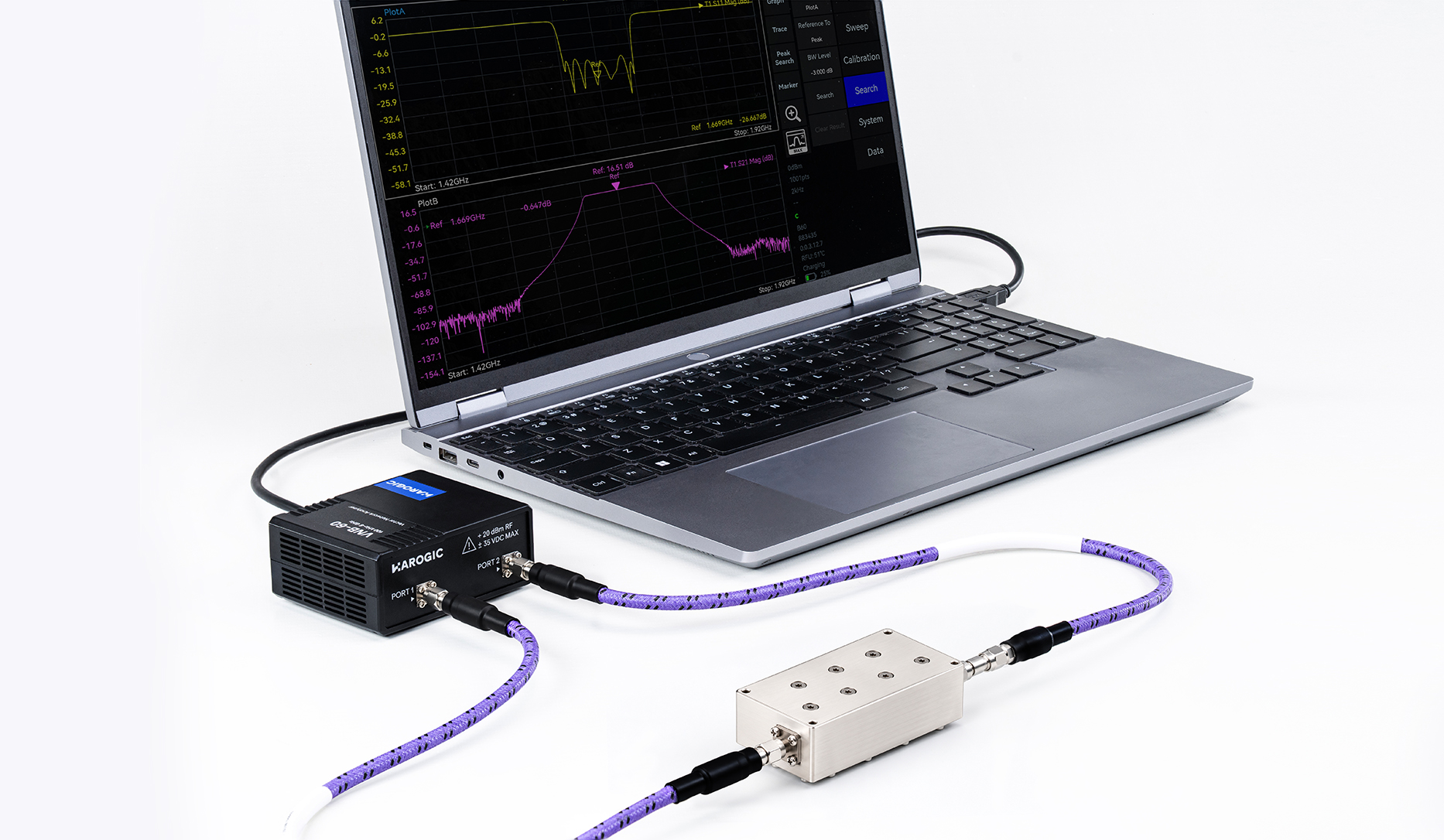
The connected computer performs the main processing and provides the user interface. The VNA application calculates measurement results such as S-parameters, applies calibration data, controls the instrument, and displays results graphically. Because the software can be installed on multiple computers, a single analyzer module can also be shared between different workstations.
2 Key Benefits and Specifications of USB VNAs
Lab-Grade Performance
Modern USB VNAs can deliver genuine lab-grade performance in a compact format. The HAROGIC VNB-60 features high-performance directional couplers with an effective directivity of 40 dB, a typical dynamic range of 100 to 120 dB, an IF bandwidth configurable from 15 Hz to 75 kHz, and sweep speeds as fast as 150 µs per point at 75 kHz IFBW.
With standard 50 Ω SMA female RF ports and an output power range of −35 dBm to +5 dBm from 10 MHz to 6 GHz, the VNB-60 provides the precision and flexibility required to characterize filters, amplifiers, cables, and antennas.

Portability and Compact Size
Without a built-in display, processor, or bulky power supply, a USB VNA can be lightweight and easy to move between laboratory benches or take into the field. The VNB-60 measures only 86 mm × 70 mm × 36 mm and weighs no more than 246 g, making it approximately the size of a deck of cards. Power, control, and data transfer are provided through a single USB 3.0/2.0 Type-C connection.
Cost-Effectiveness
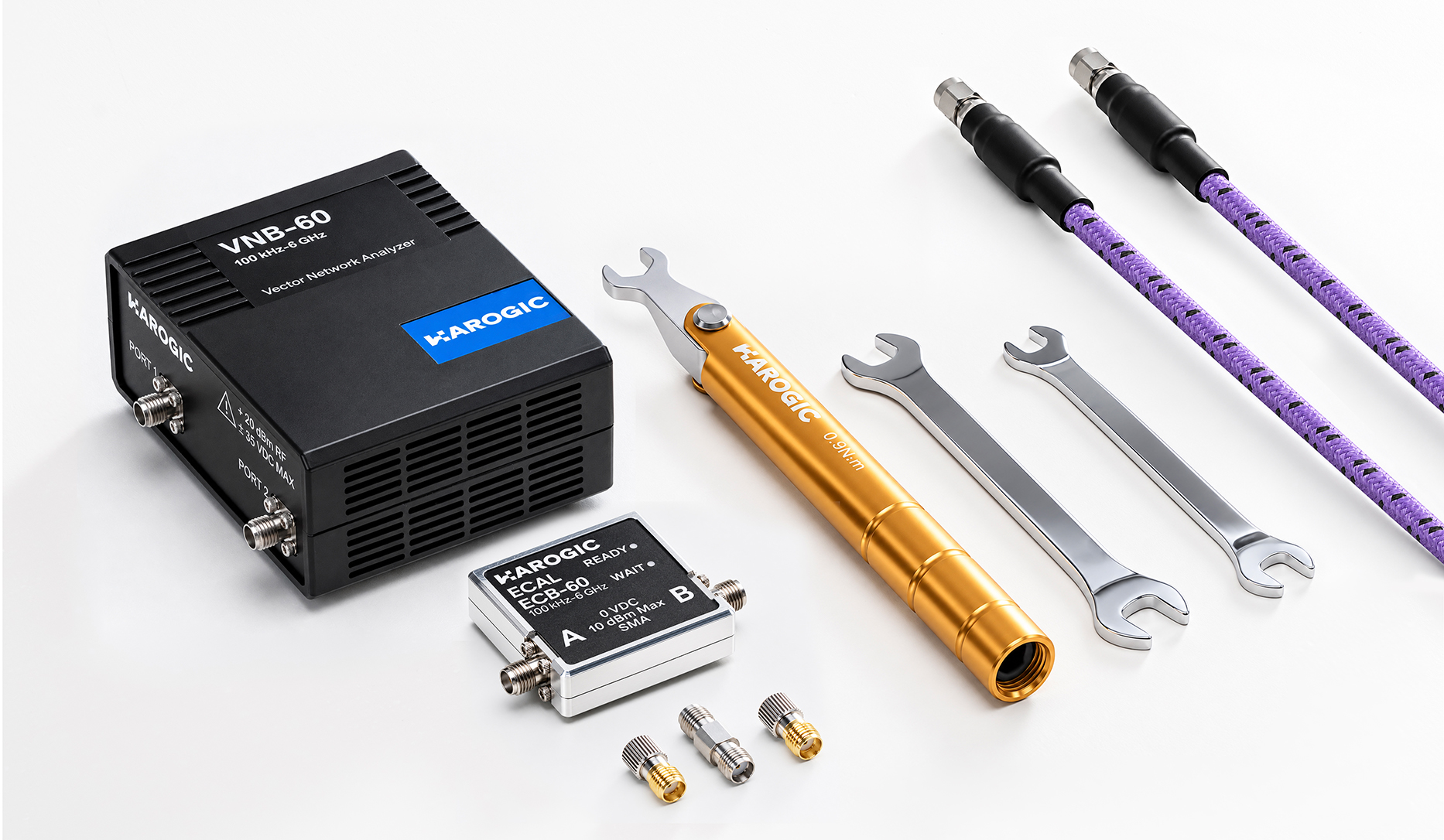
By using the processing power and display of a standard computer, a USB VNA reduces hardware requirements compared with a standalone benchtop instrument. This makes professional RF testing more accessible. The complete VNB-60 measurement set shown below is available for approximately USD 1,198.
Complete and Accessible Ecosystem
VNStudio software provides instrument control, calibration, and data visualization, including Smith charts, VSWR, and phase displays. HAROGIC also offers the ECB-60 electronic calibration module and phase-stable cables to simplify measurement setup.
Power, Connectivity, and Automation
USB VNAs are commonly powered directly through their USB connection, often using USB-C. The VNB-60 can also be automated through SCPI commands for integration into production lines and larger test systems.
3 USB VNA Components and Applications
A typical USB VNA system includes an RF measurement module, PC software and drivers, a calibration kit, and suitable RF cables. Common RF and microwave applications include:
- Component testing: Measuring the S-parameters of filters, amplifiers, attenuators, and cables.
- Antenna testing: Evaluating return loss, VSWR, impedance, and impedance matching.
- Field troubleshooting: Diagnosing cable, connector, and installed-system problems.
- Manufacturing and quality control: Automating production-line measurements for RF components.
By combining a compact RF measurement module with the processing power and convenience of a PC, a USB VNA provides a flexible and affordable route to benchtop-class vector network analysis.
4 About HAROGIC
HAROGIC combines compact, robust, high-performance RF hardware with agile and intelligent software to help customers extend RF boundaries.