





Using HAROGIC Spectrum Analyzer in GNU Radio
HAROGIC developed the gr-htra GNU Radio module to provide direct access to the measurement capabilities of HAROGIC spectrum analyzers. Together with the SoapySDR-based hardware abstraction layer, it enables HAROGIC instruments to operate as real-time IQ data sources within the flexible GNU Radio environment.
Users can acquire real-time IQ streams and visualize multiple signal-analysis views, including spectrum, spectrogram, time-domain waveform, and constellation displays. This integration brings HAROGIC spectrum analyzers into the GNU Radio open-source ecosystem, providing an efficient and flexible foundation for signal acquisition, analysis, and software-defined radio development.
1 GNU Radio Integration and Application Examples
1.1 GNU Radio Platform Integration
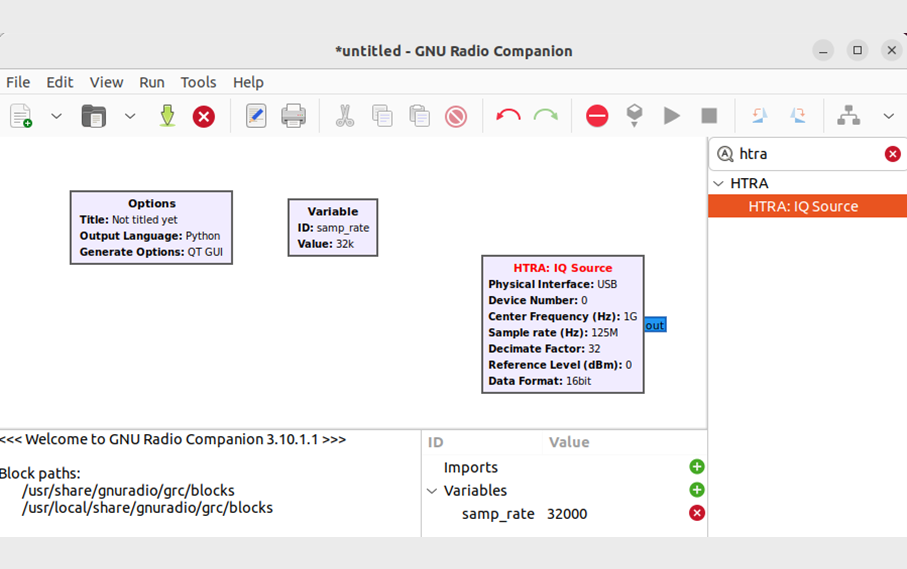
The HAROGIC gr-htra module provides driver support and data exchange for HAROGIC spectrum analyzers in GNU Radio Companion. Users can add the HAROGIC HTRA: IQ Source block to the graphical flowgraph without writing additional driver code, enabling real-time IQ acquisition, processing, and display.
HAROGIC also supports the universal SoapySDR interface, extending cross-platform compatibility and deployment flexibility. The gr-htra out-of-tree module is optimized specifically for HAROGIC devices, offering low latency and efficient execution within GNU Radio. The SoapySDR interface provides broader compatibility across applications and operating environments. Either integration method can be used to build communication, monitoring, and signal-analysis systems.

1.2 Examples and Open-Source Project Support
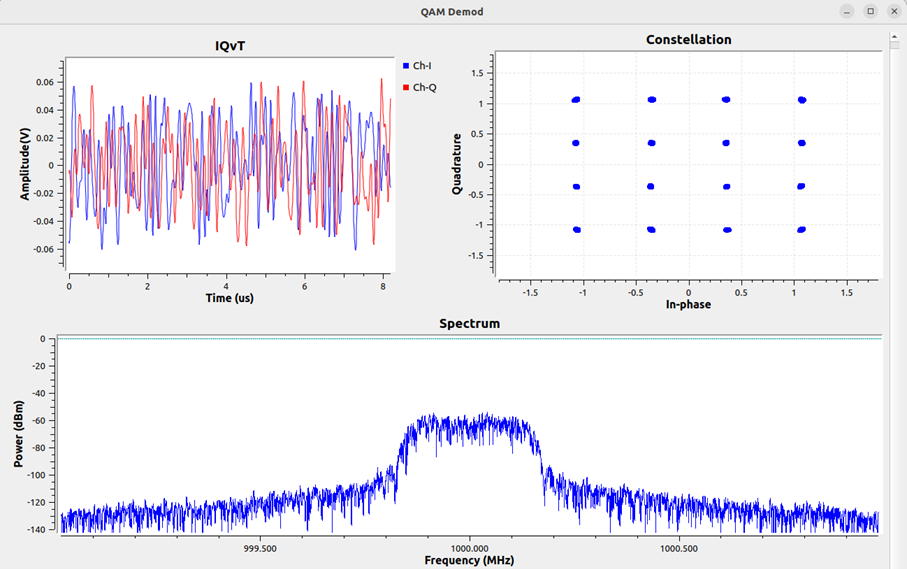
HAROGIC provides reusable signal-processing and demodulation examples, including AM and FM analog demodulation and QPSK and 16-QAM digital demodulation. HAROGIC devices can also be used with open-source projects such as gr-adsb, gr-dab, and gr-ieee802-11.
These projects support applications such as ADS-B signal demodulation with flight-path visualization, DAB digital broadcast reception, and WLAN signal demodulation. The examples run directly in GNU Radio and provide reusable starting points for algorithm verification, prototype development, system integration, and communication experiments.
The source code for gr-htra, SoapySDR integration, and the accompanying examples is available from the following GitHub repositories:
- gr-htra: https://github.com/HAROGIC-Technologies/gr-htra.git
- soapy-htra: https://github.com/HAROGIC-Technologies/soapy-htra.git

2 Extending RF Application Boundaries
HAROGIC continues to deepen its integration with the open-source ecosystem by providing flexible signal-processing tools and reusable example projects. Users can build on these resources for algorithm verification, system integration, communication experiments, and rapid prototype development.
HAROGIC devices can also be connected to real-world wireless environments for spectrum monitoring, signal capture, and demodulation, allowing GNU Radio flowgraphs to move efficiently from laboratory validation to practical deployment.
3 About HAROGIC
HAROGIC combines compact, robust, high-performance RF hardware with agile and intelligent software to help customers extend RF boundaries.