





RF Spectrum Monitoring & Regulatory Compliance with Spectrum Analyzers
1 Fundamentals of RF Spectrum Regulation and Monitoring
The Challenge of Spectrum Congestion
The radio frequency spectrum is a finite resource governed by national and international regulatory frameworks, including those established by the FCC, CEPT, and ITU. In high-density wireless environments, such as Broadway productions, stadiums, and satellite earth stations, dozens or hundreds of wireless devices may operate in close proximity across shared or adjacent frequency bands.
- UHF and VHF broadcast bands: Heavily used by wireless microphones, in-ear monitors (IEMs), and intercom systems.
- C-band, Ku-band, and Ka-band: Used for satellite communication uplink and downlink signals.
- ISM and unlicensed bands at 2.4, 5, and 6 GHz: Shared by Wi-Fi, Bluetooth, and other digital wireless equipment.
Key RF Interference Mechanisms
- Intermodulation distortion: When multiple high-power transmitters operate close to one another, nonlinear mixing can produce intermodulation products such as 2f1 − f2 or f1 + f2 − f3. These unwanted signals can interfere with channels that otherwise appear clear.
- Transient or intermittent interference: Short bursts, unauthorized transmitters, LED walls, and other digital systems can create noise-floor spikes that may be missed by slow-sweeping receivers.
- Frequency drift and excessive transmission power: Uncalibrated transmitters may operate outside their assigned spectral masks or exceed licensed power limits.
2 HAROGIC Architecture for Spectrum Monitoring
Traditional benchtop spectrum analyzers can be bulky, power-intensive, and difficult to deploy in embedded environments or mobile equipment racks. Handheld field meters, meanwhile, may lack the real-time sweep speed, low phase noise, or API integration required by automated monitoring platforms.
HAROGIC USB spectrum analyzers and receiver modules bridge this gap with a compact, high-performance architecture designed for both manual measurements and software-defined monitoring systems.
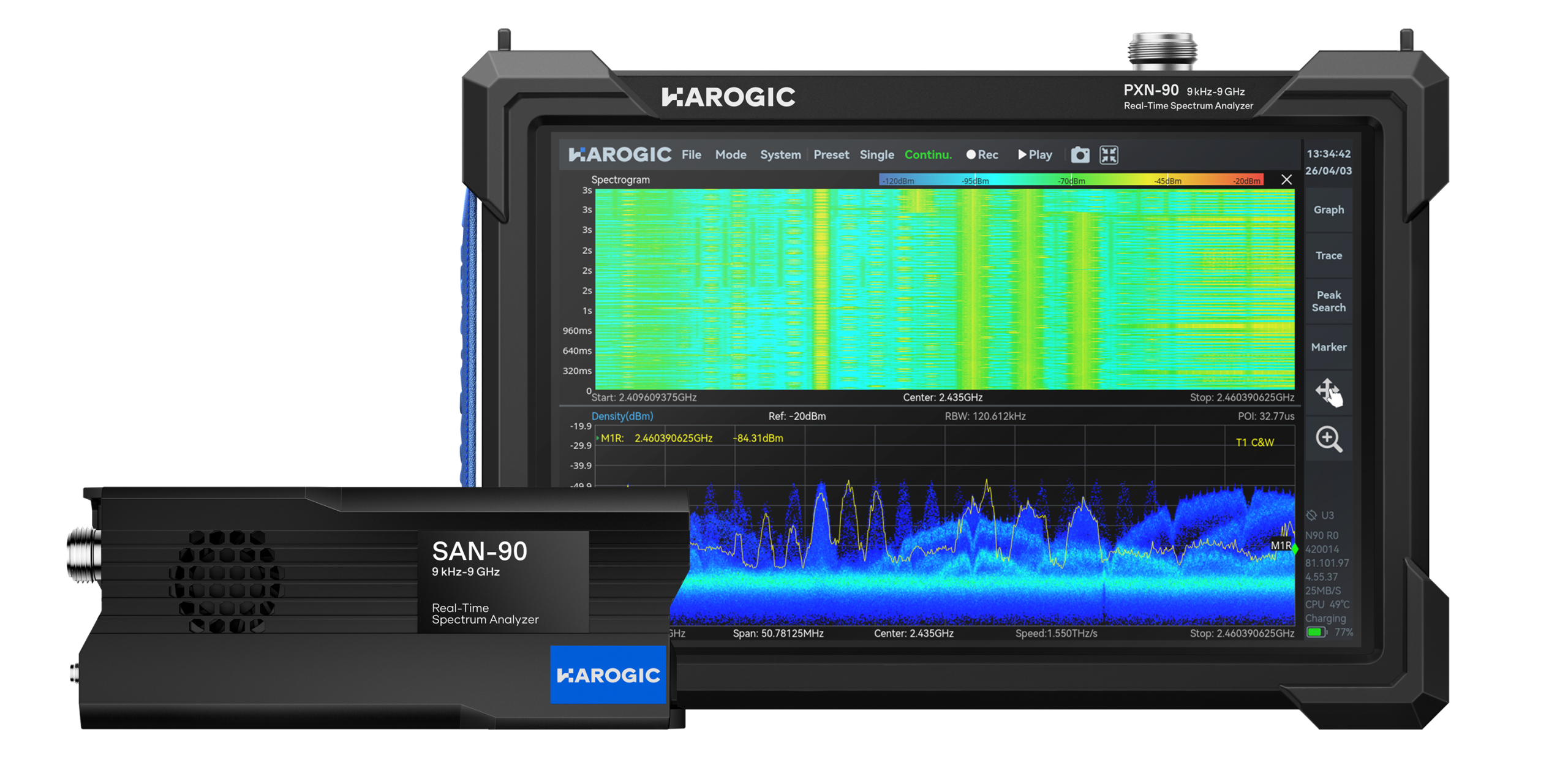
| Key Feature | SA Series | PX Series | Handheld Series |
|---|---|---|---|
| Form factor | USB | USB | Handheld |
| Frequency range | 9 kHz to 4.5/6/9/20/40 GHz | 9 kHz to 4.5/6/9/20/40 GHz | 9 kHz to 4.5/6/9/20/40 GHz |
| Phase noise at 1 GHz, 10 kHz offset | As low as −110 dBc/Hz | As low as −110 dBc/Hz | As low as −110 dBc/Hz |
| DANL at 1 GHz | −168 dBm/Hz | −168 dBm/Hz | −168 dBm/Hz |
| Weight | <500 g | 1.5 kg | 1.5 kg |
| Sweep speed at RBW = 250 kHz | Over 1 THz/s | Over 1 THz/s | Over 1 THz/s |
| Open API and multi-platform SDK | C++, Python, Linux, and Windows support | C++, Python, Linux, and Windows support | C++, Python, Linux, and Windows support |
3 Real-World RF Monitoring Applications
Live Performance and Broadcast Frequency Coordination
At major live events and theater productions, dozens of wireless microphones, IEMs, and communication systems must operate simultaneously without interference.
- Pre-show RF site audit: A HAROGIC analyzer performs a high-speed sweep of the local UHF spectrum from 470 to 698 MHz to map active television channels, noise floors, and ambient interference.
- Data export to coordination software: Raw scan data can be sent through an SDK or API to coordination tools such as SoundBase or Wireless Workbench to calculate IMD-free frequency sets.
- Continuous monitoring: During a performance, the analyzer can run in continuous sweep mode and flag conflicts when an unauthorized transmitter becomes active.
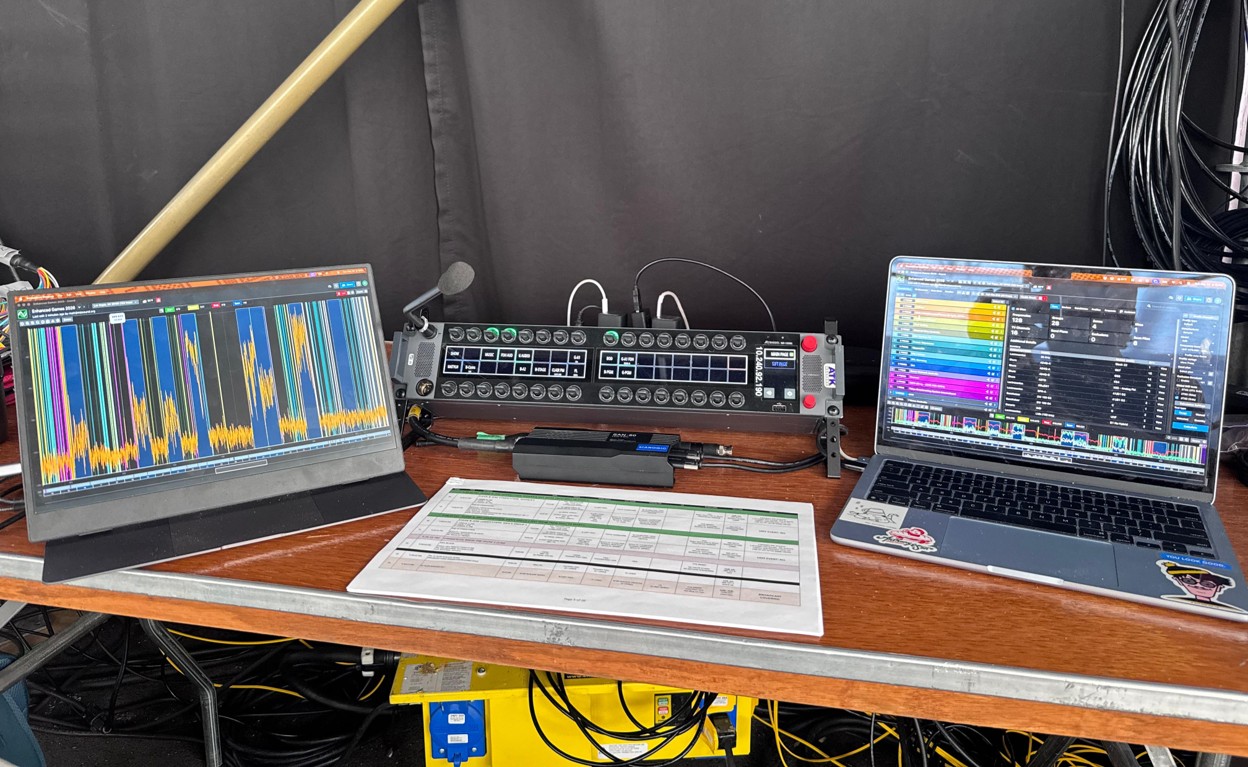
HAROGIC USB spectrum analyzers can integrate fast spectrum scanning into software workflows such as SoundBase, supporting faster coordination decisions and more reliable show-time operation.
Satellite Uplink Monitoring and Regulatory Compliance
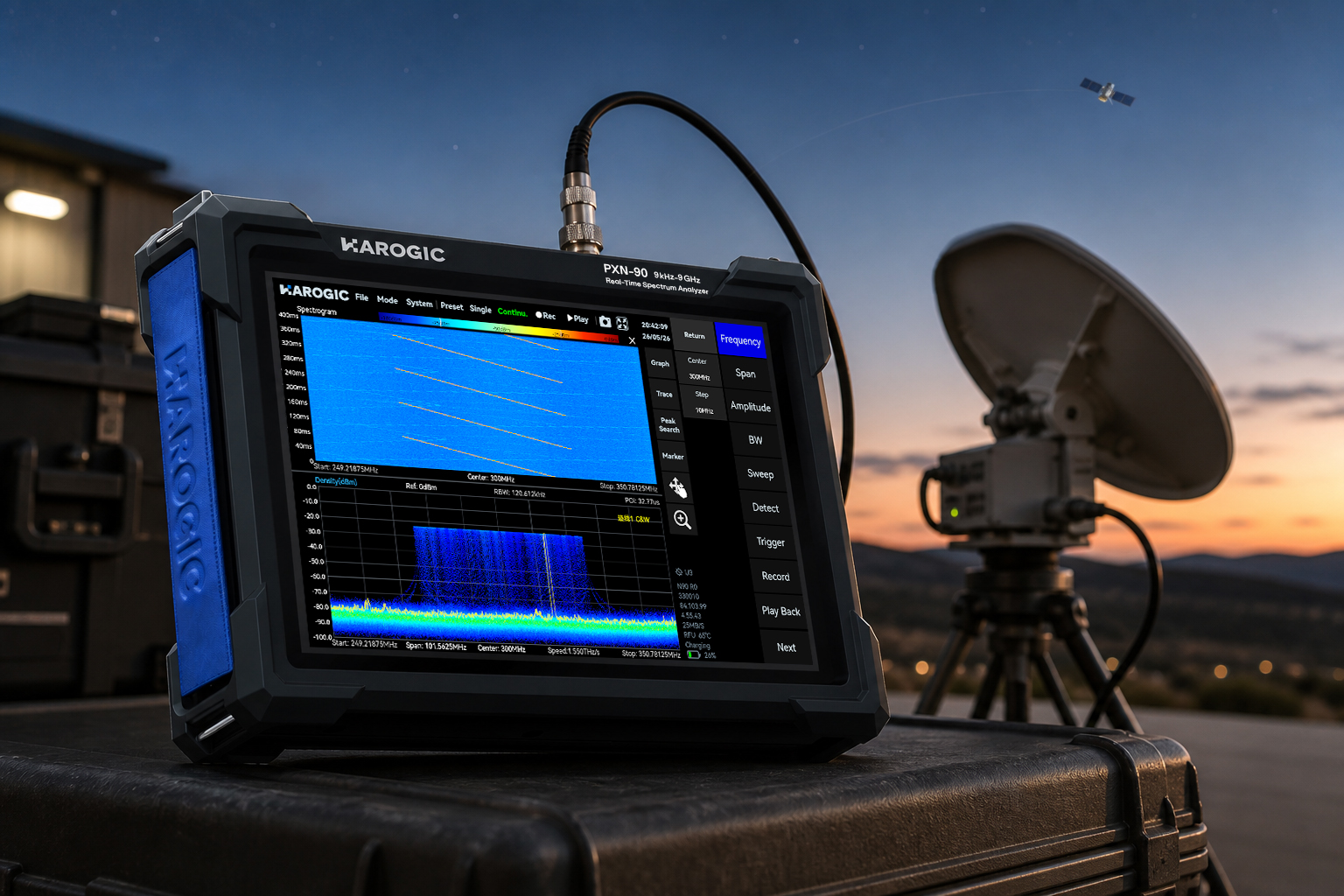
Satellite operators manage ground stations and uplink facilities that transmit high-power RF signals. Continuous spectrum monitoring helps protect allocated channels, validate signal quality, and prevent interference with adjacent services.
- Carrier-mask verification: Confirming that uplink transmissions remain within their allocated bandwidth masks to prevent interference with adjacent transponders.
- Spurious and harmonic detection: Sweeping broad frequency ranges to identify unwanted emissions from high-power amplifiers and other transmission equipment.
- Automated alarm generation: Triggering alarms through network-monitoring software when signal levels exceed defined thresholds or unauthorized emissions are detected.
4 Practical RF Monitoring Workflow
An automated RF monitoring and compliance system using a HAROGIC receiver can be implemented through the following workflow:
- Deploy the hardware: Connect the HAROGIC analyzer to a directional or omnidirectional antenna suited to the target frequency range, such as 400 MHz to 6 GHz. Install the analyzer in an equipment rack or protected field enclosure.
- Establish the baseline noise floor: Run an initial scan during an RF-quiet period to identify fixed broadcast transmitters and ambient environmental noise.
- Configure masks and thresholds: Define upper spectral limits and event durations. Signals that exceed the defined limits can then generate event records.
- Integrate APIs and reporting: Connect the HAROGIC C++ or Python API to a centralized network-management dashboard to automate compliance reports, event notifications, and historical analysis.
5 Conclusion
Effective RF spectrum regulation and monitoring require high dynamic range, fast sweep rates, and reliable software integration. HAROGIC spectrum analyzers provide the high-performance RF frontend needed for applications ranging from live-venue frequency coordination to continuous satellite-uplink compliance monitoring.
6 About HAROGIC
HAROGIC combines compact, robust, high-performance RF hardware with agile and intelligent software to help customers extend RF boundaries.