


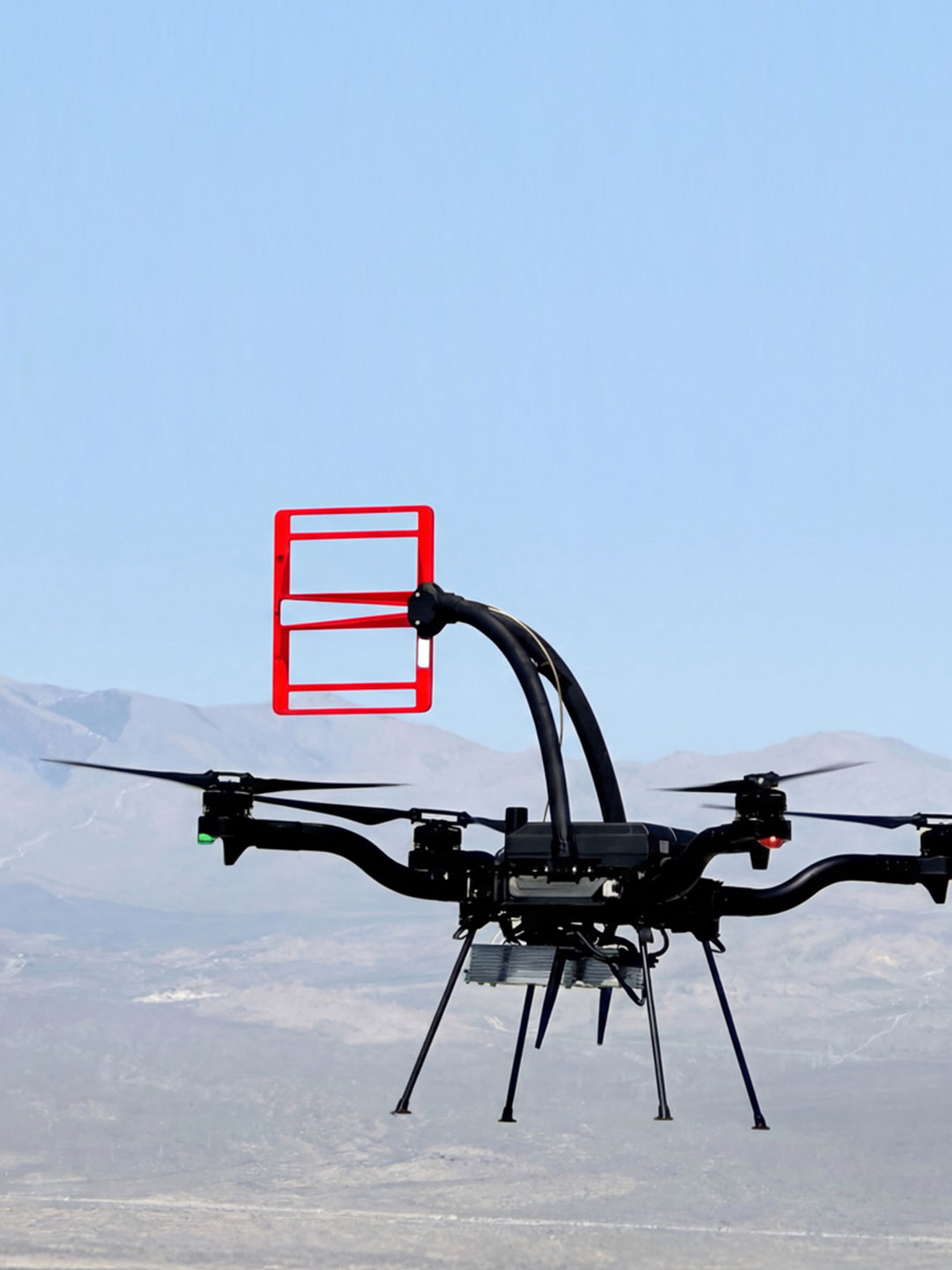
1 System Overview
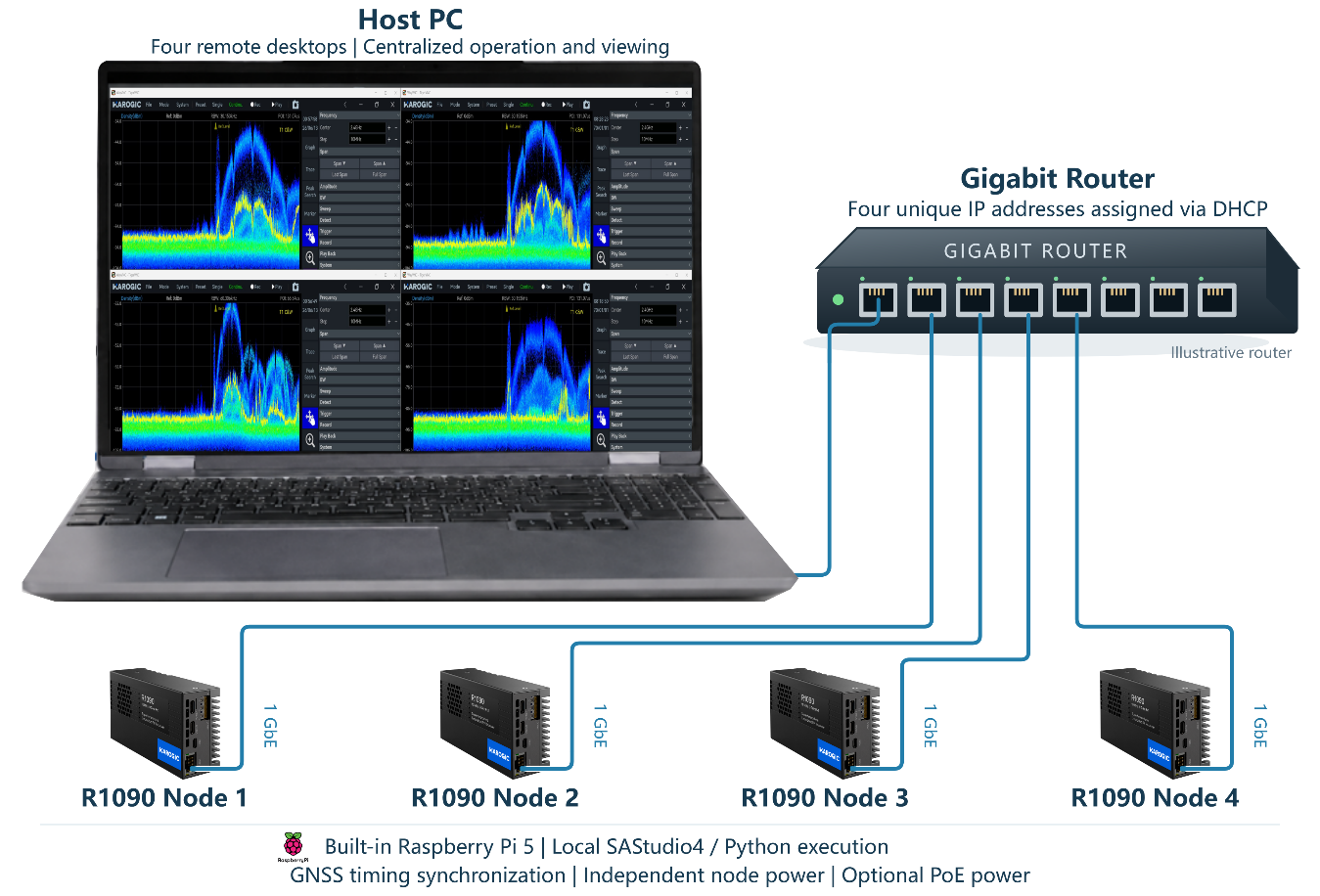
The R1090 multi-node demonstration system comprises four R1090 RF receivers, a DHCP-enabled router, and a host PC. It demonstrates network connectivity, remote operation, and local signal processing across multiple devices. All four receivers connect to the same LAN over Gigabit Ethernet and receive IP addresses from the router. The host PC accesses each node through a separate remote desktop session.
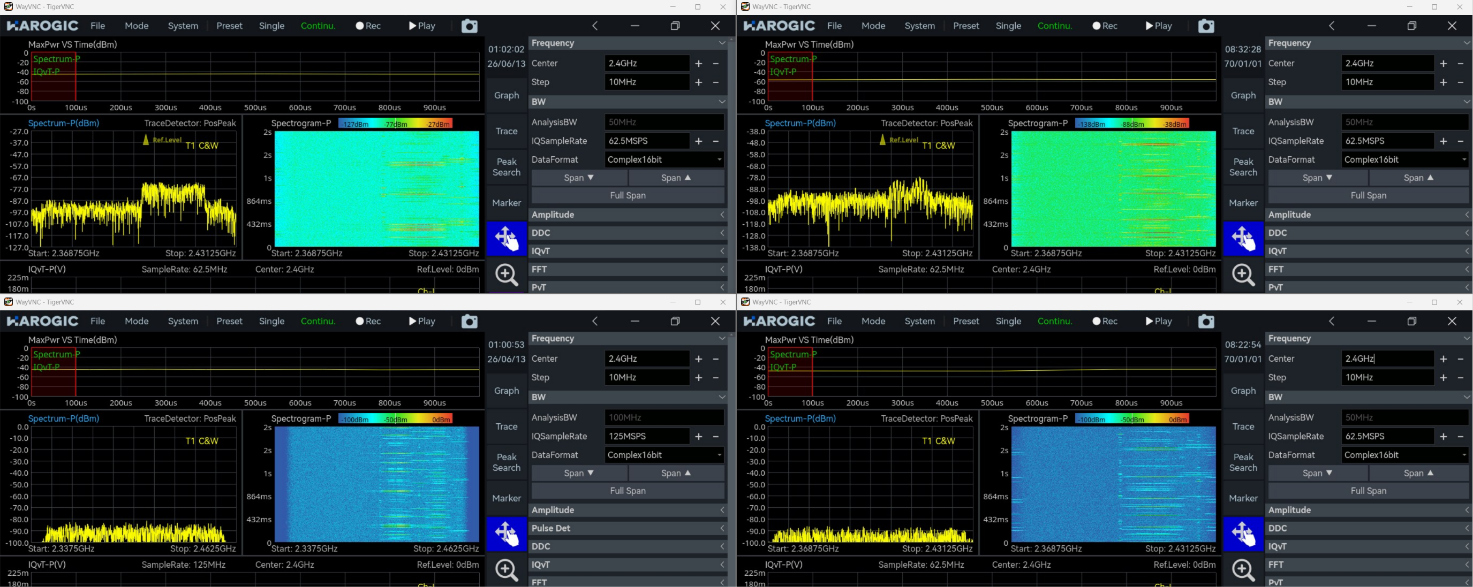
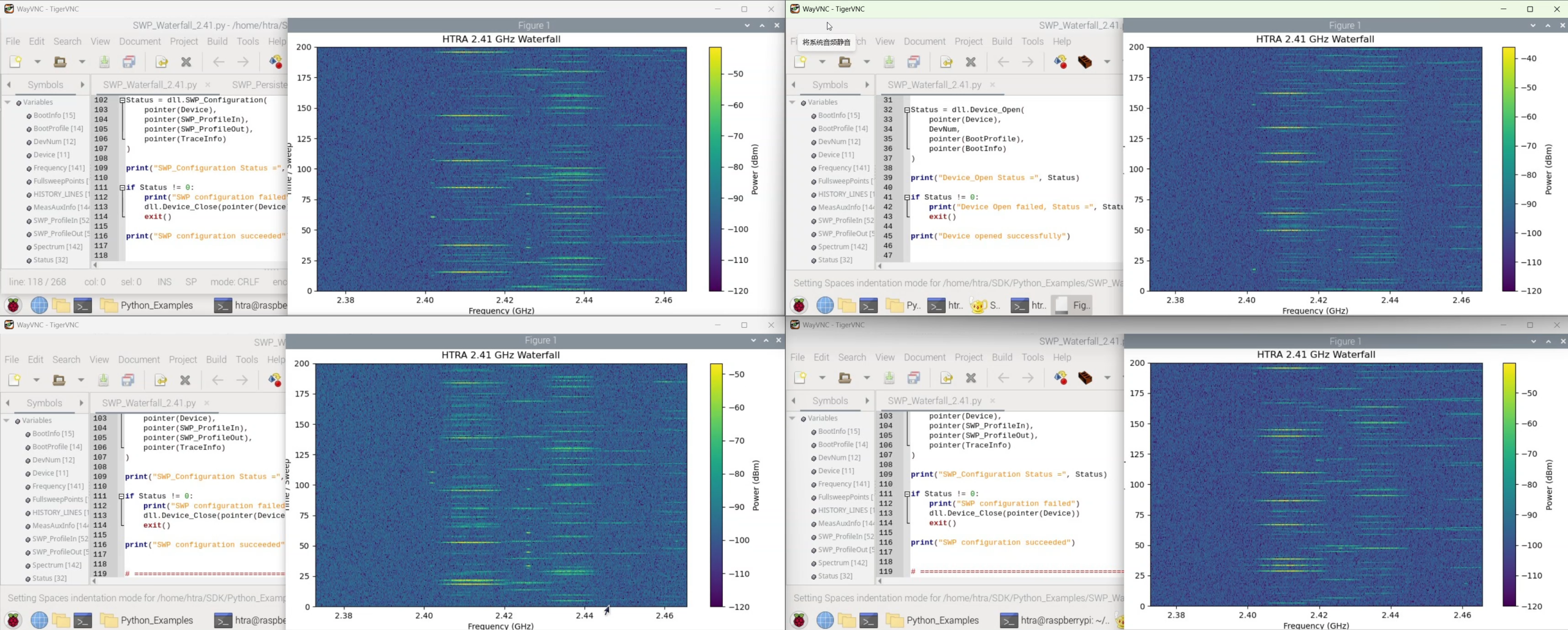
Each R1090 includes a Raspberry Pi 5 and can independently run SAStudio4 or Python programs. SAStudio4 enables quick verification of receiver settings and signal observation. Python programs acquire data through the HTRA API and perform spectrum, persistence, and waterfall processing locally on each node. The host PC displays the node interfaces together for centralized operation and comparison of results.
2 Demo Images
3 Key Technical Features
- Network Connectivity: A multi-node network is built using 1 GbE and DHCP. Receiver settings can be configured independently on each node, with centralized access from the host PC.
- Local Processing: The Raspberry Pi 5 supports custom programs at the acquisition node. These can implement spectrum statistics, event detection, and local recording, with results or IQ data sent back as needed.
- Positioning and Time Correlation: Built-in GNSS provides positioning and timing. Combined with PPS triggering and IQ timestamps, it provides a basis for aligning data in time across nodes. Precise IQ alignment requires verification of trigger and timestamp settings and measurement of the actual alignment error.
- Development Ecosystem: In addition to the Python programs used in this demonstration, the accompanying SDK can be used to develop applications with C++, Qt, C#, GNU Radio, and other environments.
4 Demonstration and Application Development
This demonstration shows the R1090's network-based multi-node connectivity and custom programming capabilities, providing a basis for the following applications:
- Fixed Unattended Nodes: Deploy continuously operating acquisition nodes to monitor band occupancy and changes in the electromagnetic environment.
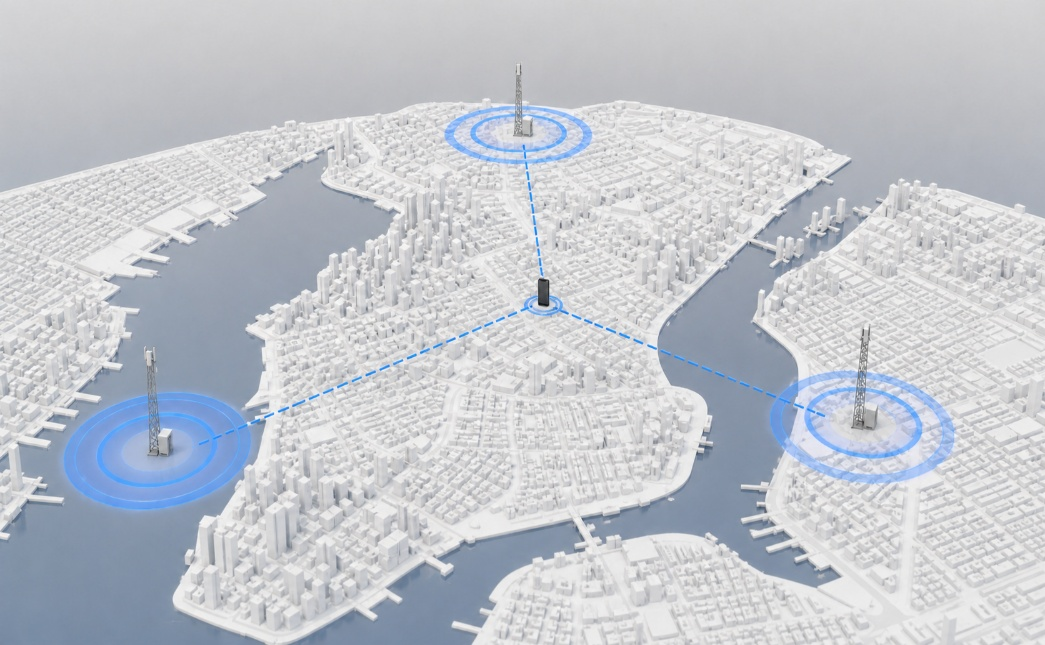
- Distributed Signal Anomaly Analysis and Spectrum Monitoring: Acquire signals in parallel at different locations or in different frequency bands for anomalous signal detection, spectrum comparison, and cross-node event correlation.
- Multi-Node Networking and Remote Program Deployment: Connect multiple R1090 receivers over a network and remotely deploy custom acquisition and processing programs on individual nodes to build a multi-node acquisition network.
- Distributed Electromagnetic Spectrum Situational Awareness: Aggregate data from multiple nodes using a common time reference and consistent statistical methods to analyze signal distributions and changes across time, space, and frequency.
5 Hardware and Software
| Hardware | Software |
|---|---|
| Four R1090 receivers, supplied power adapters, and HOA-80 antennas | SAStudio4 or Python demonstration programs running on each node |
| DHCP-enabled router, Ethernet cables, and a host PC | Remote desktop client, HTRA API, and accompanying SDK |
6 Reference Resources
- HAROGIC Resources: R1000 Series User Manual and Programming Guide
- HAROGIC GitHub Resources
 Back to Cooperation