




From Waveform Generation to Field Deployment in One Device
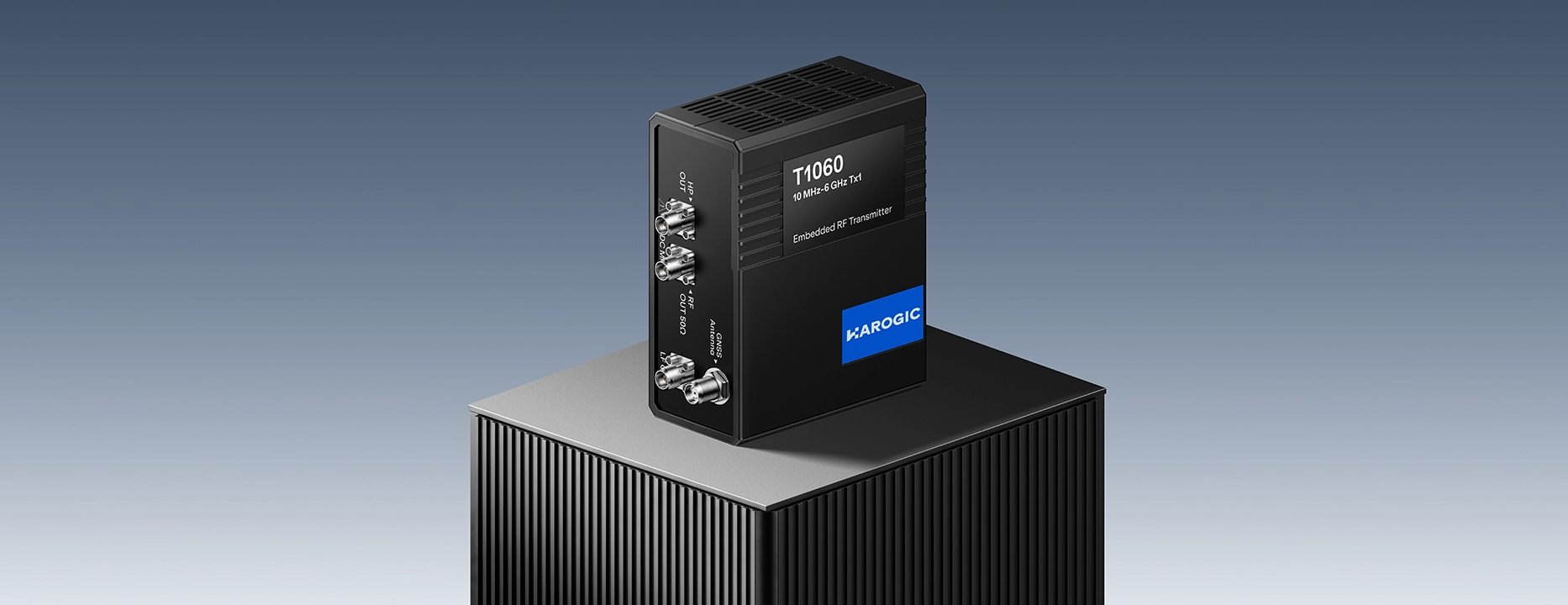
Measuring just 86 × 77 × 36 mm and weighing 281 g, the T1060 integrates an RF transmit chain, FPGA and DAC, waveform storage and playback, an embedded host, clock synchronization, and system interfaces in a compact enclosure.
External clients can send parameters, waveforms, and tasks over 1 GbE. Alternatively, the built-in Raspberry Pi 5 can handle waveform management, storage, playback, and control logic on the device. This brings task execution closer to the edge and reduces reliance on a continuously connected remote host computer.
Wide Frequency Coverage and Low Phase Noise
The T1060 covers 10 MHz to 6 GHz. Under typical test conditions, phase noise is as low as −124 dBc/Hz at a 10 kHz offset from a 1 GHz carrier, providing a stable RF foundation for high-quality RF stimulus generation and scenario reproduction.
Wide Output Dynamic Range and Spectral Purity
The standard T1060 offers a maximum output power of 7 to 14 dBm, depending on the frequency band, and a minimum output power of ≤ −100 dBm. An optional medium-power version provides a maximum output power of ≥ 25 dBm.
At an output level of 0 dBm, typical harmonics are ≤ −50 dBc, with amplitude accuracy maintained within 2 dB. This combination of output power, amplitude control, and spectral purity supports tasks ranging from receiver sensitivity testing to system-level RF stimulus generation.
FPGA Onboard Memory Playback and Continuous Streaming
The T1060 features a 16-bit DAC and supports an IQ sample rate of up to 125 MS/s, with the following playback capabilities:
- FPGA onboard memory waveform playback with up to 100 MHz signal bandwidth. A 128 MB waveform buffer holds up to approximately 32M complex IQ samples.
- Continuous IQ streaming playback from the embedded Raspberry Pi 5 host’s eMMC storage, with up to 50 MHz bandwidth.
High-bandwidth memory playback is suited to reproducing transient, pulsed, and complex wideband signals, while continuous streaming supports long-duration waveform generation with dynamic updates.
Embedded Computing and Flexible Deployment
The built-in Raspberry Pi 5 has a quad-core 2.4 GHz processor, 4 GB of RAM, and 32 GB of eMMC storage. Users can control the device remotely from a Windows or Linux host computer, or deploy waveforms, scripts, and applications on the device for standalone operation, choosing flexibly between remote network control and local autonomous execution.
A Unified and Open Development Path
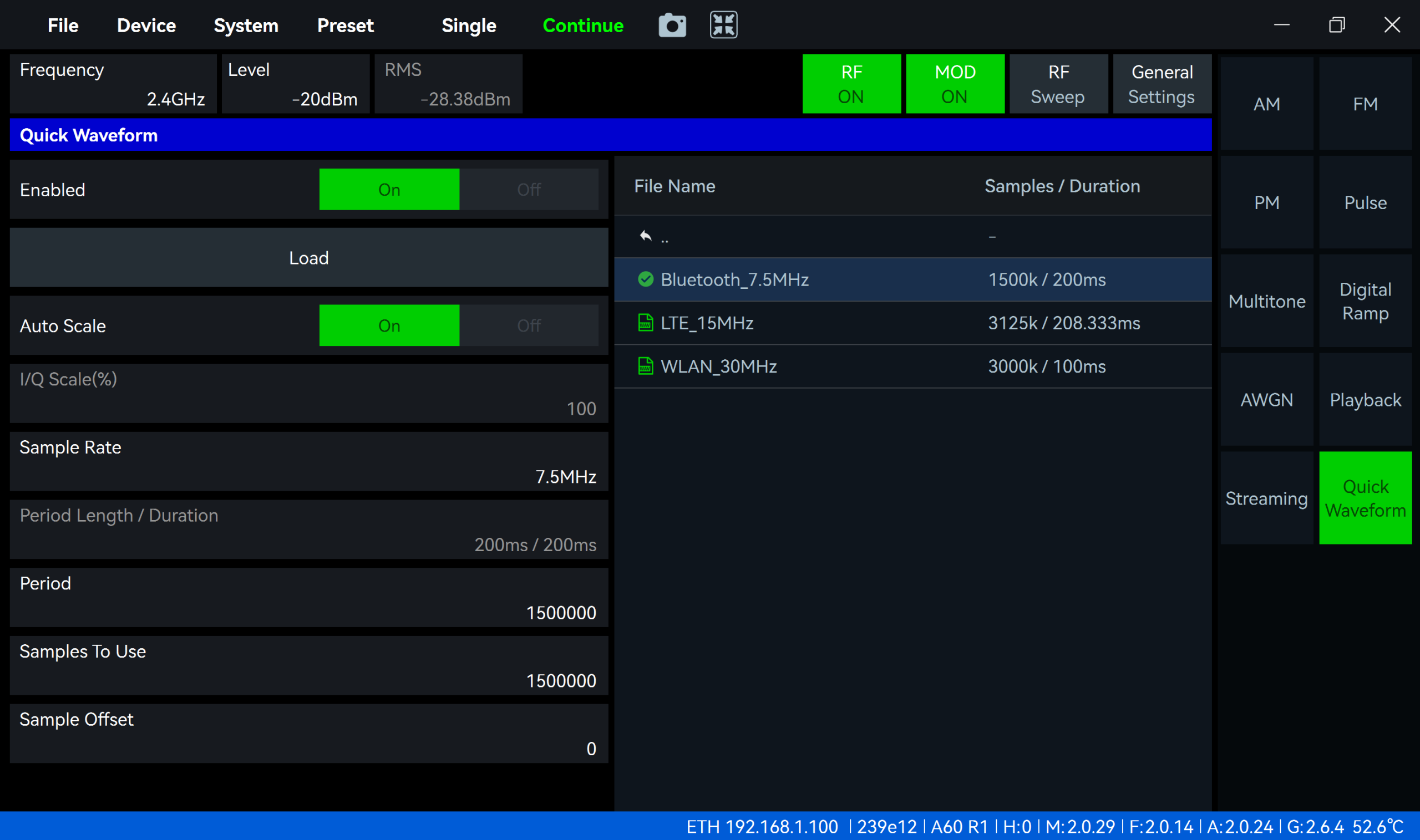
The companion SGStudio software supports device configuration, functional verification, modulated signal generation, and custom waveform playback. SGStudio includes a range of analog and digital modulation waveform functions, with further capabilities available through options, helping users quickly generate their first signal and verify device operation.
Through its unified API, the T1060 can be integrated with development environments including C/C++, C#, Python, MATLAB, Qt, LabVIEW, and GNU Radio, with support for Windows and Linux. Users can reuse existing algorithms, scripts, and automated test assets without rebuilding their entire device control infrastructure.
Interfaces and Form Factor for System Integration
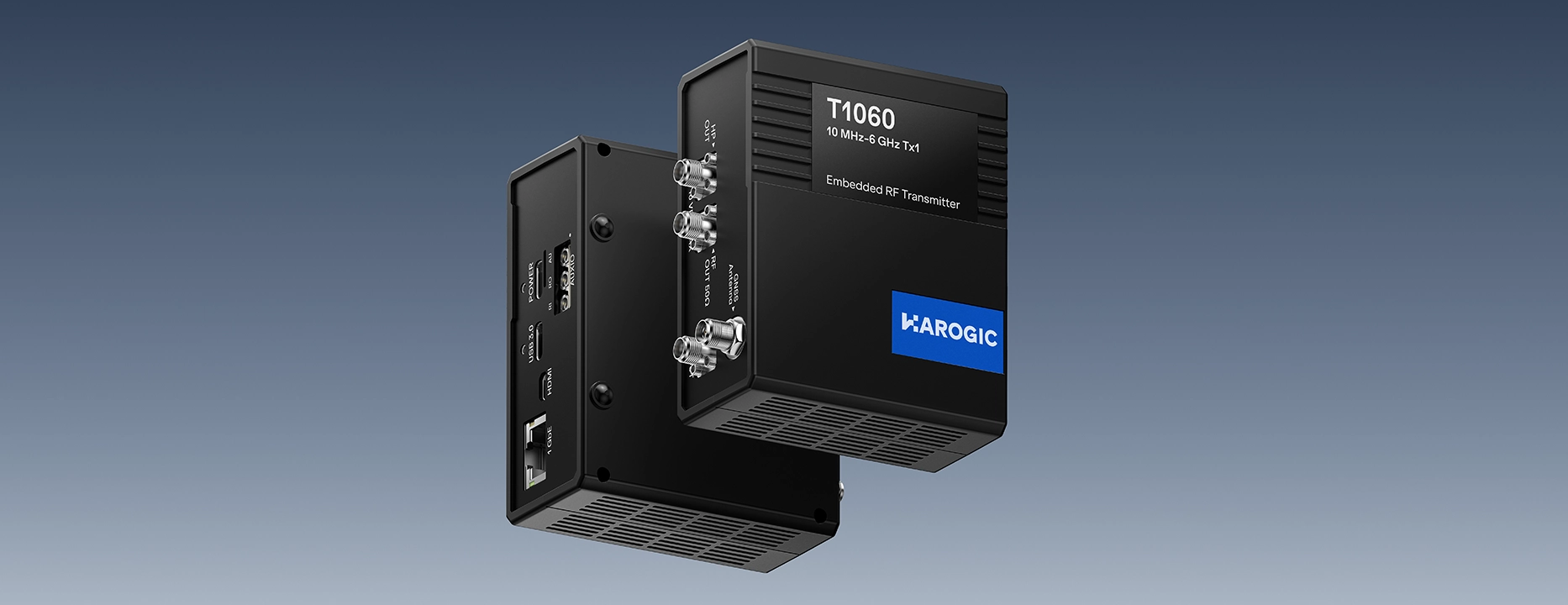
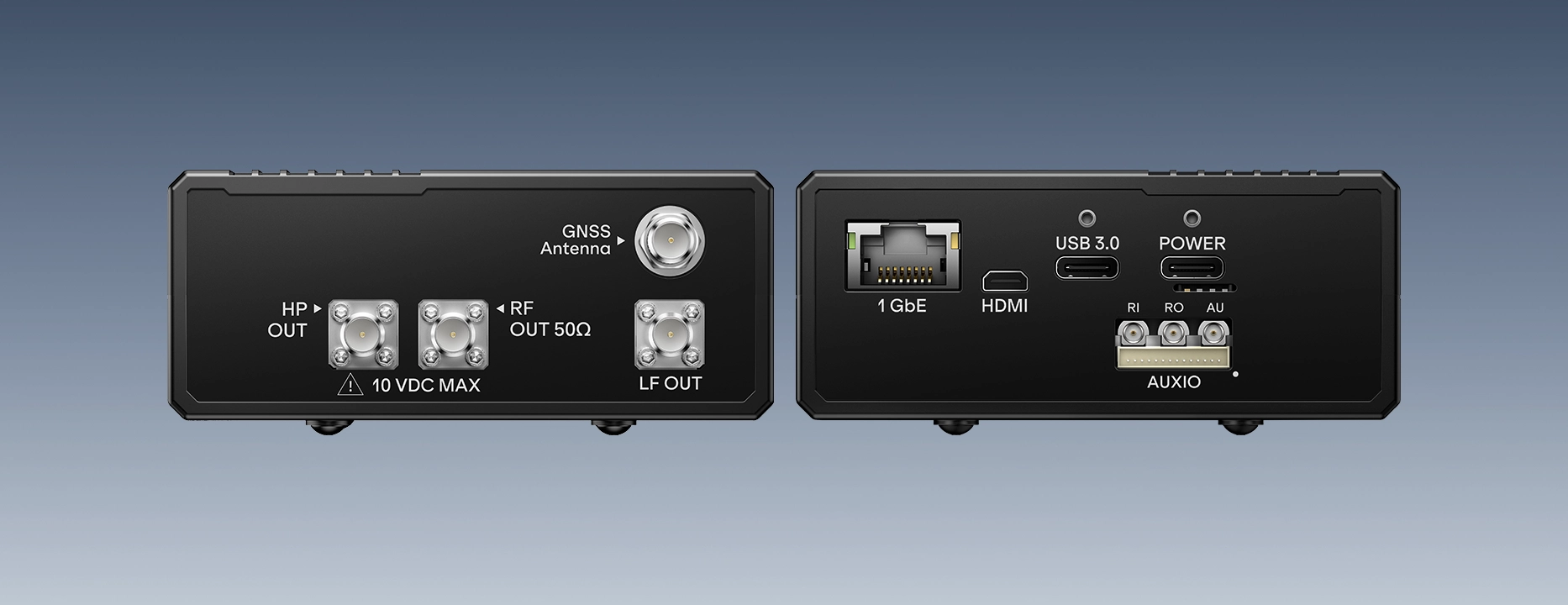
The T1060 provides system interfaces including 1 GbE, a reference clock interface, and AUXIO, enabling expansion for fixed installations, remote deployment, and OEM system integration.
A Remotely Controlled and Programmable Field Node
The T1060 control path runs from the host computer over 1 GbE to the device’s embedded host. Waveform and control tasks then pass through the FPGA, DAC, and RF chain to RF OUT.
This architecture supports network management and remote automation while allowing tasks, waveforms, and control logic to run directly at the edge. Even if the external network is temporarily interrupted, tasks deployed in advance on the edge device can continue to run according to their configured logic.
Compared with conventional distributed setups built from an external computer, RF boards, power supplies, clocks, and custom control modules, the T1060 brings these key capabilities together in a complete, systematically engineered node. This helps reduce:
- The number of external computers and supporting hardware components;
- Custom development for RF, clock, power, and control interfaces;
- Software rework when moving from a validation platform to a deployment platform;
- Configuration differences and integration risks when replicating systems at scale.
Users can employ the same hardware, interfaces, and control logic throughout development, validation, deployment, and scaled replication, keeping the prototype validation environment as consistent as possible with the final application environment.
From Rapid Validation to Open Development
For users who need to begin transmitting quickly, SGStudio provides basic parameter settings, built-in waveform generation, and custom waveform playback. It supports direct configuration and playback of carriers, modulated signals, and IQ waveforms.
For teams building custom systems, the T1060’s unified API supports custom application development. Users can control the device from a host computer or deploy applications written in C/C++, Python, and other languages to run directly on the device.
With Raspberry Pi OS, mature Linux drivers and development tools, and the extensive Raspberry Pi open-source ecosystem, developers can draw on existing networking resources, databases, web services, Docker, GNU Radio, and algorithm frameworks to integrate RF transmission into broader application systems.
Waveforms, scripts, and control logic created during development can then be deployed to run on the device, shortening the path from prototype validation to field application.
Three Typical Use Cases
- Custom Waveforms Generation: Users can import IQ waveforms they generate themselves or record with a receiver to reproduce anomalies.
- Wireless Scenarios and Distributed Synchronized Stimuli: With local computing, a reference clock, and GNSS synchronization capabilities, the T1060 can coordinate RF stimulus tasks across multiple nodes for communications, radar, target simulation and distributed experiments. Tasks and waveforms can be stored on different nodes in advance and coordinated through the network, triggers, or a common time reference, reducing the impact of centralized data transfer on network bandwidth and real-time control.
- Remote Unattended RF Transmission: The T1060 can store waveforms and tasks locally, with parameter delivery, task initiation, and status reporting handled over the network. It can be deployed in remote laboratories or field test locations, reducing the need for repeated site visits with conventional benchtop signal generators.
A Complete Record and Playback Validation Workflow with R1000
The T1060 can be used with HAROGIC R1000 series embedded RF receivers. Once the RF parameters have been matched, IQ data recorded in the field by an R1000 can be imported into the T1060 and retransmitted in the laboratory, creating a complete RF validation workflow:
Field Recording → Laboratory Reproduction → Algorithm Regression Testing → System Integration Testing
This workflow helps R&D teams identify problems, validate algorithm changes, and complete regression testing for new versions.
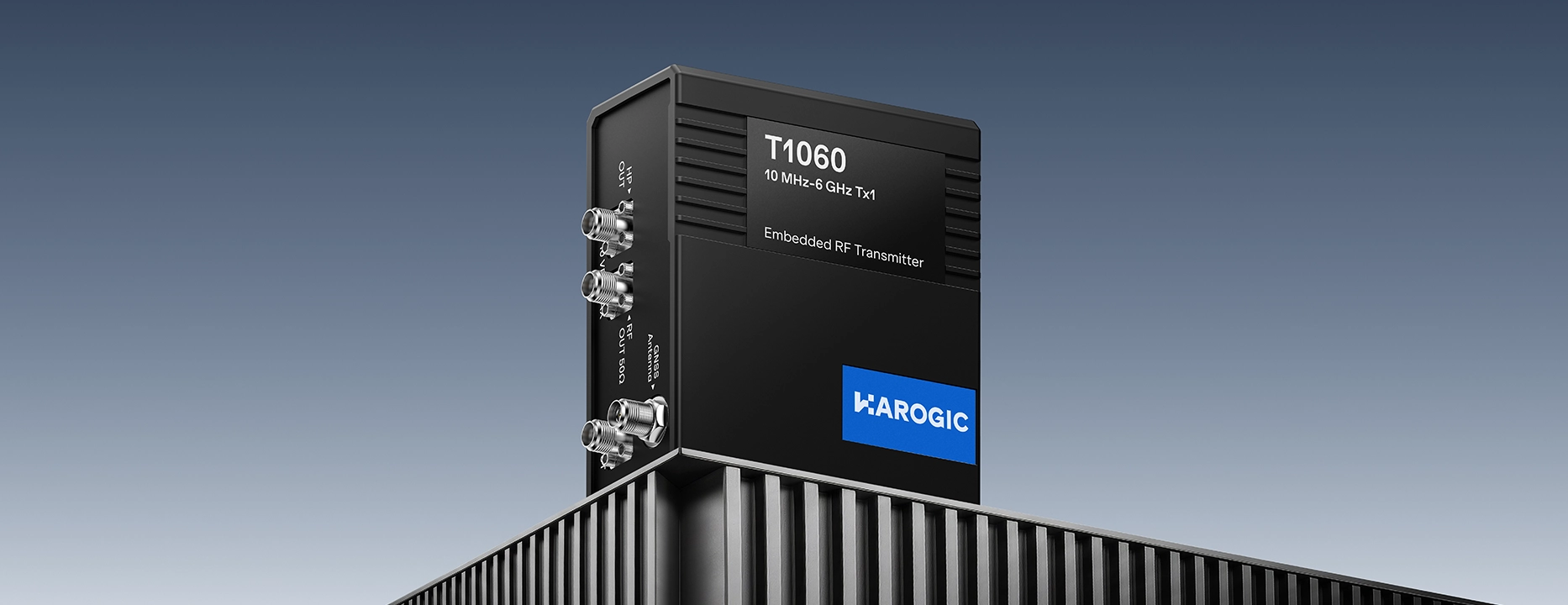
From standalone waveform playback to networked test nodes, the T1060 can connect to existing software and automation workflows through a unified interface and use its powerful onboard edge computing capabilities to execute tasks in the field.
For deployments at scale and applications that demand reliable long-term operation, the T1060 uses a highly integrated, all-in-one design, with thermal management, structural strength, power delivery, and cable connections engineered at the system level.
About HAROGIC
HAROGIC combines compact, robust, high-performance RF hardware with agile, intelligent software to help customers extend RF boundaries.