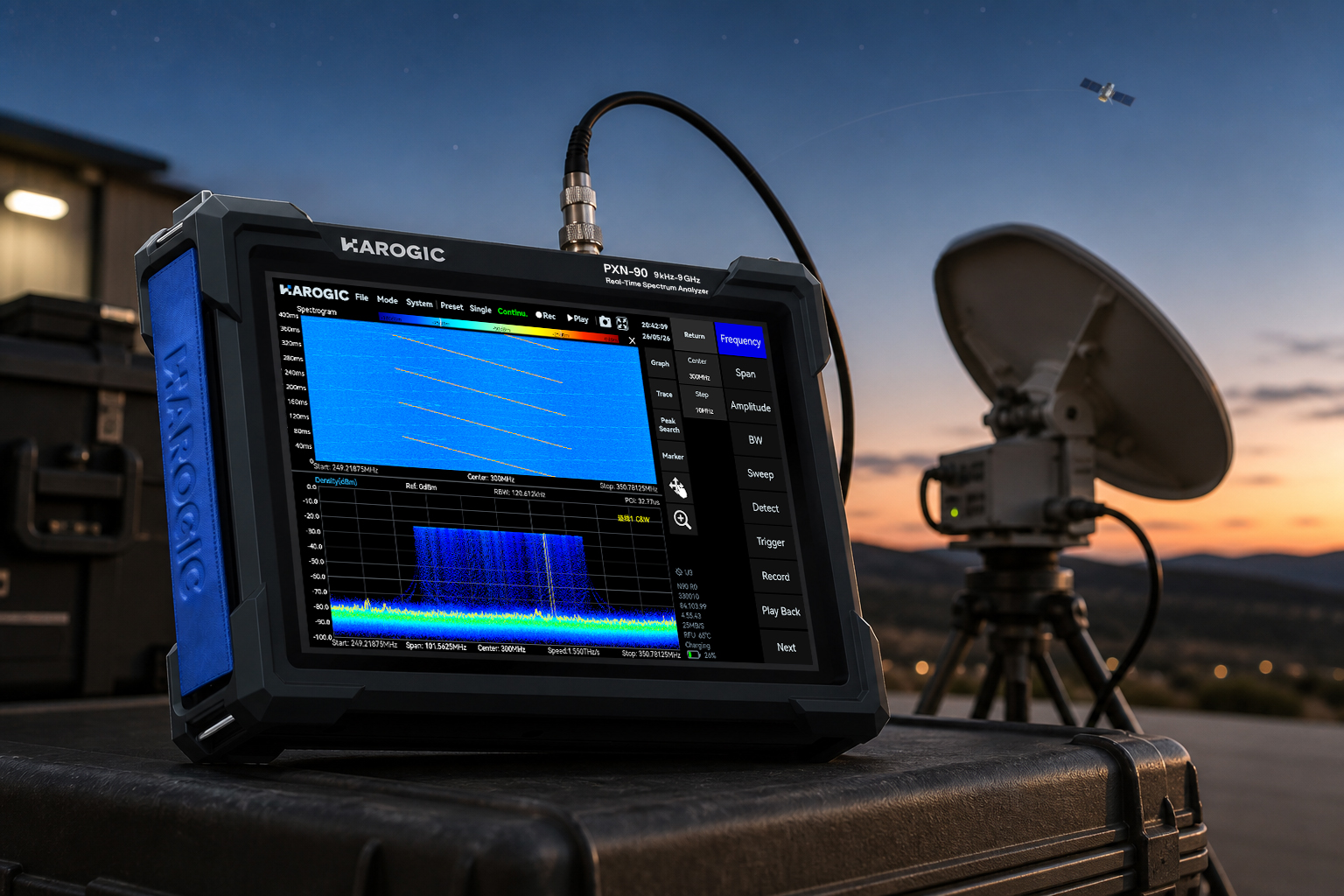






Real-Time RF Spectrum Monitoring & Regulatory Compliance
08 / 10 2026
As wireless environments become increasingly congested, real-time RF spectrum monitoring is essential for maintaining spectrum hygiene, preventing interference, and ensuring regulatory compliance. This article explains how HAROGIC Spectrum Analyzers support live event frequency coordination, satellite uplink monitoring, and automated RF compliance workflows.
Fundamentals of RF Spectrum Regulation & Monitoring
The Challenge of Spectrum Congestion
The radio frequency spectrum is a finite resource governed by global regulatory bodies, including FCC, CEPT, and ITU. In high-density wireless venues, such as Broadway productions, stadiums, and satellite earth stations, dozens or hundreds of wireless devices operate in close proximity across shared or adjacent bands.
UHF/VHF Broadcast Bands: Used heavily for wireless microphones, In-Ear Monitors (IEMs), and intercoms.
C-Band / Ku-Band / Ka-Band: Used for satellite communication (SatCom) uplink and downlink signals.
ISM & Unlicensed Bands (2.4 GHz / 5 GHz / 6 GHz): Congested with Wi-Fi, Bluetooth, and digital wireless equipment.
Key RF Mechanisms to Mitigate
Intermodulation Distortion (IMD): When multiple high-power transmitters operate close to each other, non-linear mixing produces intermodulation products, such as f_IMD = 2f1 - f2 or f1 + f2 - f3. These ghost signals cause unexpected interference on supposedly clean channels.
Transient / Intermittent Interference: Short-burst signals, rogue transmitters, or local LED/digital wall noise floor spikes that escape traditional slow-sweeping receivers.
Frequency Drift & Over-Power Transmissions: Uncalibrated transmitters operating outside designated spectral masks or exceeding licensed power limits.
Technical Solution: HAROGIC Architecture Advantage
Traditional benchtop spectrum analyzers are bulky, power-hungry, and difficult to deploy in embedded environments or mobile racks. Conversely, handheld field meters often lack the real-time sweep speed, low phase noise, and API integration required for automated software platforms.
HAROGIC USB Spectrum Analyzers and Receiver modules bridge this gap with a compact, high-performance architecture.
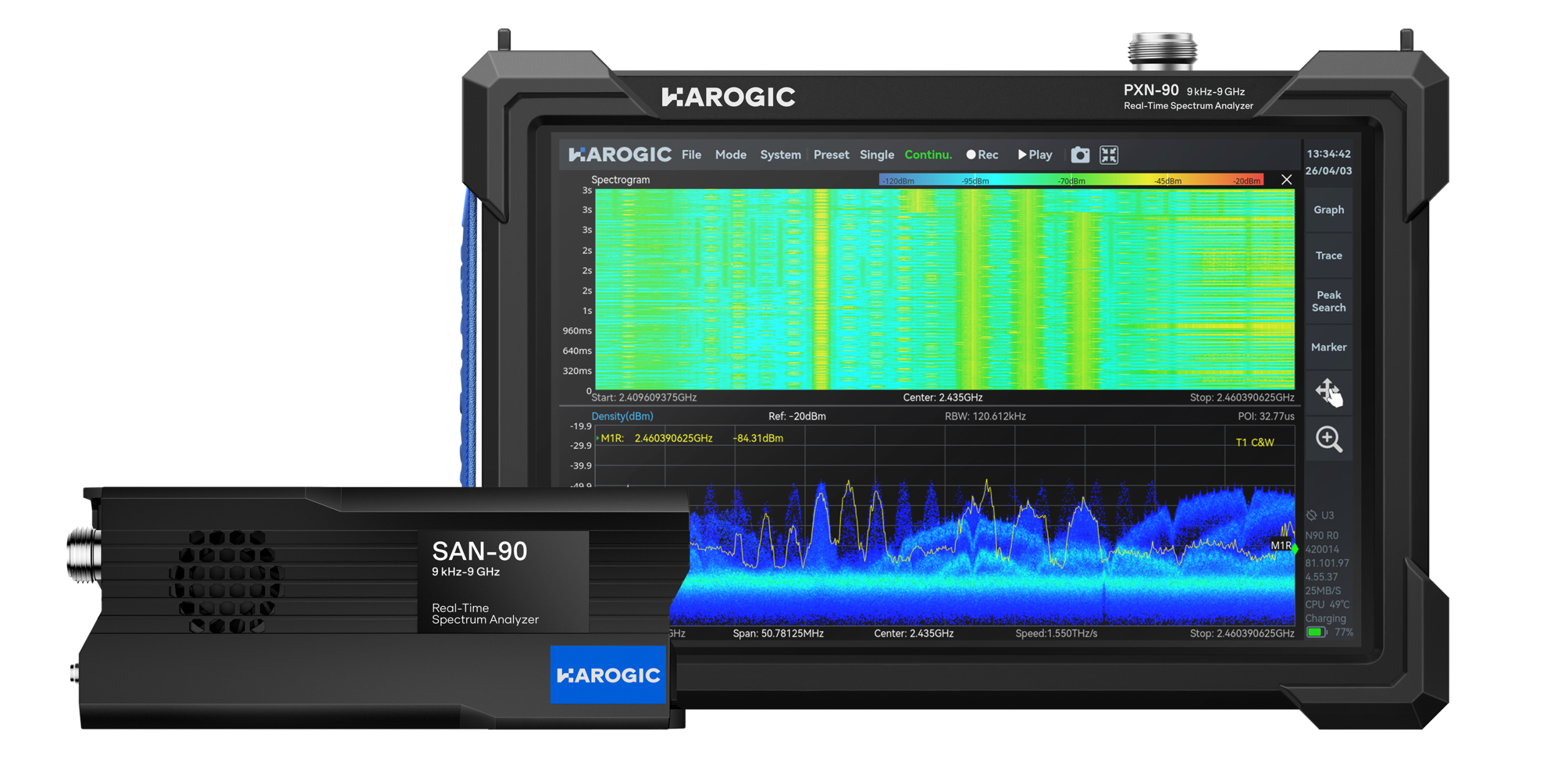
| Key Feature | SA Series | PX Series | Handheld Series |
|---|---|---|---|
| Form factor | USB | USB | Handheld |
| Frequency range | 9 kHz-4.5/6/9/20/40 GHz | 9 kHz-4.5/6/9/20/40 GHz | 9 kHz-4.5/6/9/20/40 GHz |
| Phase noise, 1 GHz @10 kHz offset | As low as -110 dBc/Hz | As low as -110 dBc/Hz | As low as -110 dBc/Hz |
| DANL, 1 GHz | -168 dBm/Hz | -168 dBm/Hz | -168 dBm/Hz |
| Weight and Size | <500 g | 1.5 kg | 1.5 kg |
| Sweep speed, RBW=250 kHz | Over 1 THz/s | Over 1 THz/s | Over 1 THz/s |
| Open API & Multi-Platform SDK | C++/Python/Linux/Windows support for custom control. | C++/Python/Linux/Windows support for custom control. | C++/Python/Linux/Windows support for custom control. |
Real-World Application Scenarios
Scenario A: Live Performance & Broadcast Frequency Coordination
In major live events or theater productions, dozens of wireless microphones, IEMs, and comms systems must operate without interference.
Pre-Show RF Site Audit: The HAROGIC analyzer performs a high-speed sweep of the local UHF spectrum (470-698 MHz) to map active TV channels, noise floors, and ambient interference.
Data Export to Coordination Software: Raw scan data is fed directly via SDK or API into coordination tools, such as SoundBase or Wireless Workbench, to calculate IMD-free frequency sets.
Continuous Monitoring: During the performance, the analyzer runs in continuous sweep mode. If an unauthorized transmitter turns on, the system flags the conflict in real time.
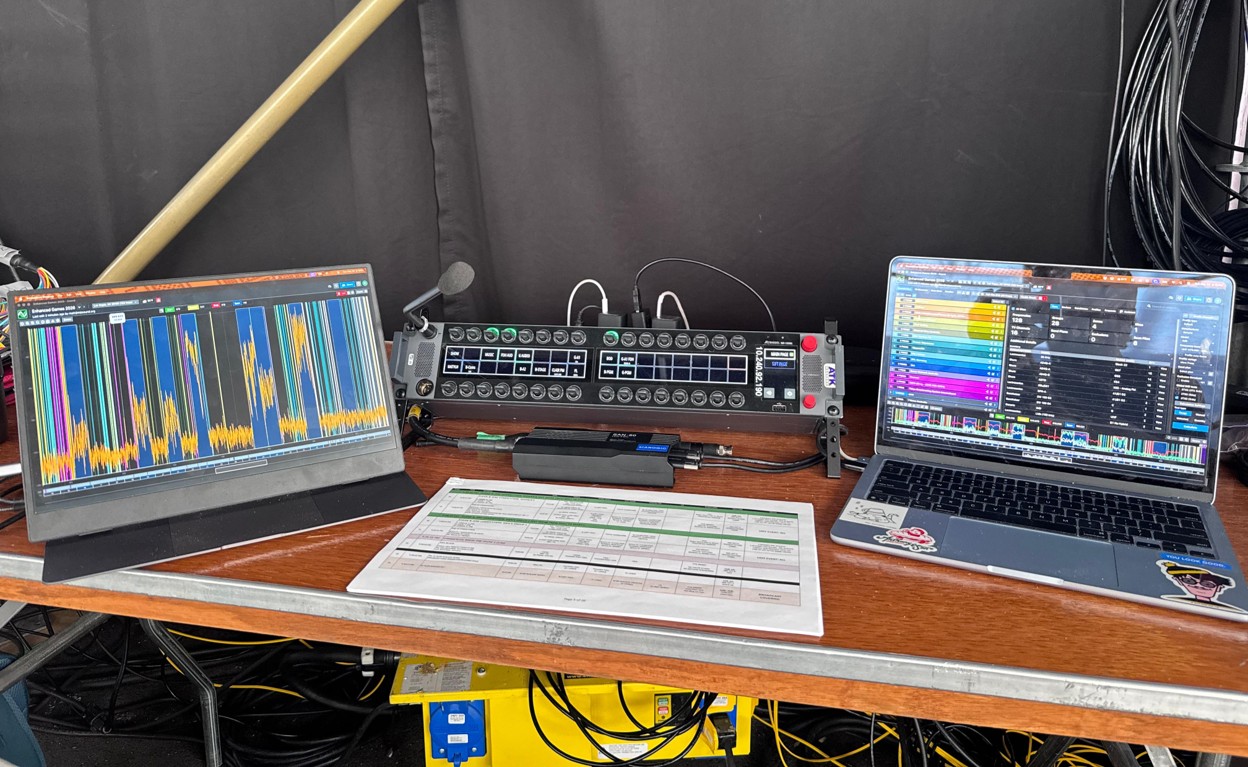
With HAROGIC USB spectrum analyzers, RF teams can integrate fast spectrum scanning into software workflows such as SoundBase, supporting faster coordination decisions and more reliable show-time operation.
Scenario B: Satellite Uplink Monitoring & Regulatory Compliance
Satellite operators manage ground stations and uplink facilities transmitting high-power RF signals. In this environment, continuous spectrum monitoring is essential for protecting allocated channels, validating signal quality, and avoiding interference with adjacent services.
Carrier Mask Verification: Ensuring uplink transmissions strictly adhere to allocated bandwidth masks to prevent adjacent transponder bleedover.
Spurious & Harmonic Hunting: Continuous sweep across broad frequency bands to detect unwanted non-harmonic spur emissions from high-power amplifiers (HPAs).
Automated Alarm Generation: When signal levels exceed allowed thresholds or rogue emissions are detected, the HAROGIC receiver triggers automated alarms via network monitoring software.