






Introduction
In RF testing, a tracking generator (TG) is a signal source whose output frequency follows the sweep frequency of a spectrum analyzer. A standard spectrum analyzer is a passive instrument that receives and displays signals. When a tracking generator is added, the analyzer becomes part of an active test setup that can evaluate how a device such as a filter, cable, or amplifier performs across frequency.
This capability is widely used in practical RF measurements. However, in some test scenarios, users need the signal source to work independently from the spectrum analyzer frequency. In those cases, a conventional tracking generator is not flexible enough.
To address this requirement, the new HAROGIC PXN Series includes a built-in signal generator that can work not only as a tracking generator, but also as an independent source for broader application needs.
What Is a Tracking Generator?
A tracking generator is internally synchronized with the spectrum analyzer. As the analyzer sweeps from the start frequency to the stop frequency, the tracking generator outputs a pure sine wave at the same instantaneous frequency.
This allows users to observe how a device under test responds across a frequency range. It is a practical solution for swept measurements and is commonly used for component characterization in RF labs and field applications.
Limitations of a Conventional Tracking Generator
Although a tracking generator is useful for frequency response measurements, it is linked to the analyzer sweep and cannot operate independently as a continuous wave (CW) source.
For some applications, users need the signal generator and the spectrum analyzer to perform different tasks. In these cases, an independent built-in source provides much greater flexibility. It allows the source to operate at a fixed frequency or under dedicated sweep conditions while the analyzer measures a different signal behavior.
Built-In Signal Generator in the New PXN Series
To meet these application requirements, HAROGIC designed a new built-in signal generator for the PXN Series. It supports both traditional tracking generator functionality and independent signal source operation, expanding the practical use cases of the instrument.
| Model | TG-45 | TG-60 | TG-90 |
|---|---|---|---|
| Frequency range | 1 MHz to 4.5 GHz | 1 MHz to 6 GHz | 1 MHz to 9 GHz |
| Mode | FixedPoint, FreqSweep, PowerSweep, Tracking Generator (TG) | FixedPoint, FreqSweep, PowerSweep, Tracking Generator (TG) | FixedPoint, FreqSweep, PowerSweep, Tracking Generator (TG) |
| Frequency resolution | 10 Hz | 10 Hz | 10 Hz |
| Power resolution | 0.25 dB | 0.25 dB | 0.25 dB |
| Power level | -20 dBm to 0 dBm | -20 dBm to 0 dBm | -20 dBm to 0 dBm |
| Power level accuracy | ±2 dB | ±2 dB | ±2 dB |
Typical Applications
1. Tracking Generator Applications
With the tracking generator mode, the PXN Series can support several common RF tests:
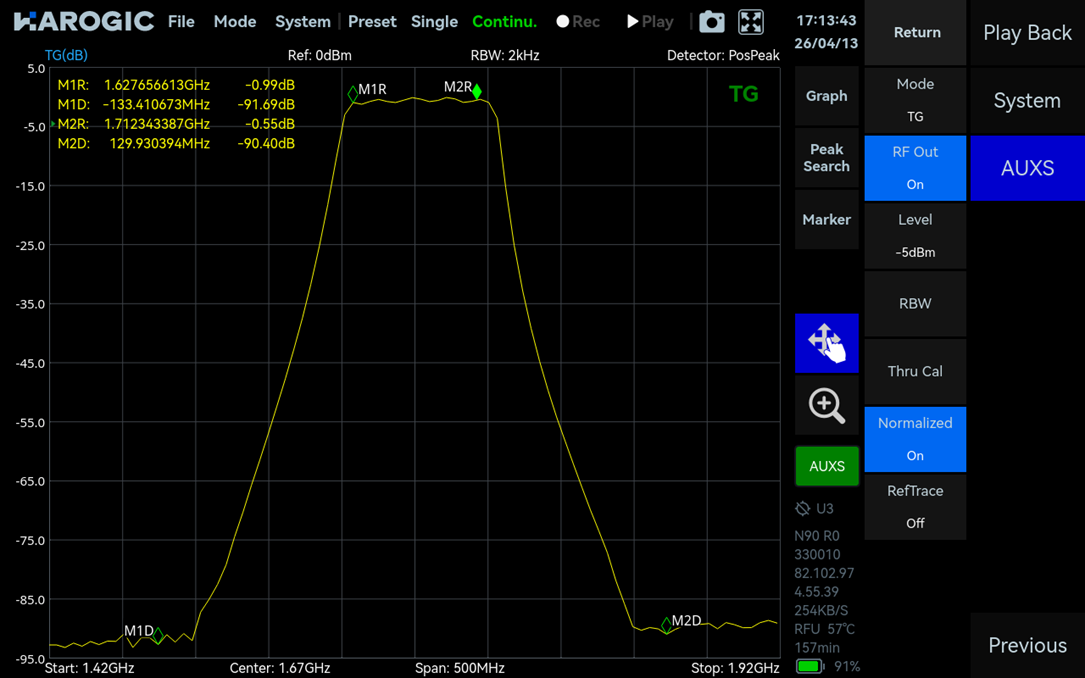
Filter characterization
Users can observe the passband, cutoff frequency, and rejection performance of filters such as band-pass and low-pass filters.
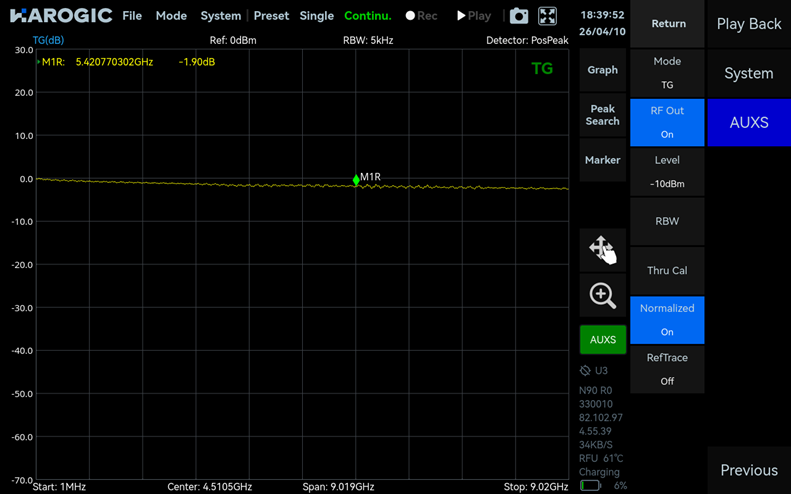
Cable loss testing
By connecting a cable between the source and analyzer, users can measure insertion loss across frequency and evaluate cable performance over its operating range.
Amplifier gain measurement
The tracking generator can be used to check the gain flatness of an amplifier across its working bandwidth.
2. Standalone Signal Generator Applications
When used as an independent source, the built-in generator supports more flexible measurement setups.
Frequency decoupling
Unlike a tracking generator, the source can be set to a fixed CW frequency while the spectrum analyzer sweeps a different frequency range.
Power sweep capability
The source can automatically step output power, for example from -20 dBm to 0 dBm, while staying at a fixed frequency. This is useful for linearity-related measurements.
Power Sweep and Gain Compression (P1dB)
One common application of an independent source is amplifier compression testing. By sweeping the input power into an amplifier while the spectrum analyzer monitors the output at a fixed frequency, users can identify the 1 dB compression point, where the amplifier begins to saturate and deviate from linear behavior.
Multi-Tone / Intermodulation Distortion (IMD) Testing
If the analyzer uses its internal source together with an external signal generator and a power combiner, the setup can create a two-tone signal.
This allows users to evaluate third-order intercept performance (TOI/IP3), an important indicator of amplifier and receiver quality.
Receiver Characterization (LO Substitution)
The built-in generator can also be used as a local oscillator (LO) source for mixer or receiver testing. While the internal source provides the fixed LO signal, the spectrum analyzer can sweep the intermediate frequency (IF) output to evaluate conversion loss and spurious responses.
Conclusion
A tracking generator is an effective tool for swept frequency response testing, but some RF applications require a signal source that can operate independently from the analyzer sweep. By integrating both tracking generator and standalone signal generator capabilities, the new PXN Series supports a wider range of test scenarios and gives users more flexibility in practical RF measurements.
About HAROGIC
HAROGIC combines compact, robust, and high-performance RF hardware with agile and intelligent software to help customers extend RF boundaries.
 Back to Cooperation